Hypersphere HealthPatient 3-D™ See it on your data

How it works

The back end you can inspect. The front end your clinicians already use.

Hypersphere Health is a healthcare company; the platform is how complete care reaches the patient. The Patient Engine reads every source, scores every patient in three dimensions and fires the protocol. The care team sees it inside the EHR they already work in. Same patient, same story, from the first record to the closed loop.

The story, beat by beat

One patient. Back end first, then the front end.

The same nine beats you will see on the live platform and in every conversation with us.

  1. 1

    They compound.

    Three controlled conditions, a mid-range score, no flags. Underneath, her heart, kidneys and diabetes are making each other worse.

    RISK SCORE · MID-RANGE · NO FLAGS
    COMPOUNDING · NEPHROLOGY ≤ 48 H
  2. 2

    Her data arrives from everywhere, as it happens.

    In production, every source feeds her record as it happens: admissions, results and orders from the EHR, claims, pharmacy fills and notes. Each event rescores her at once.
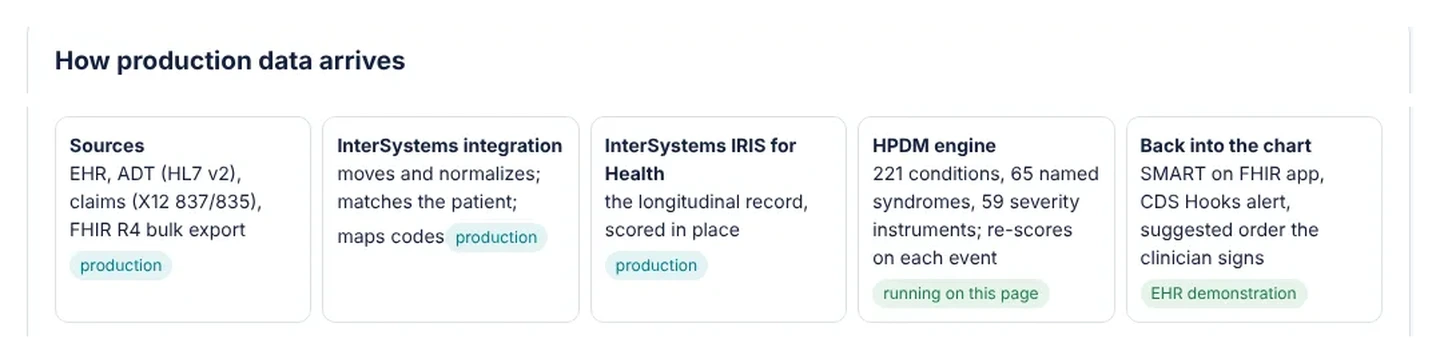
    Her data arrives from everywhere, as it happens.
    Illustrative patientsRecorded from the platform engine
  3. 3

    Every source counts, and the gap is the finding.

    The engine identifies what other systems document that her own record does not carry; the clinician validates. The gap shows where systems don’t talk.

  4. 4

    Seen in three dimensions.

    Breadth, severity, and how her conditions compound. Social barriers named, notes read, what is already done kept done.

  5. 5

    The physician decides.

    At chart open: the finding, the reason and the guideline. Accept, change or dismiss; nothing enters the chart without the clinician.
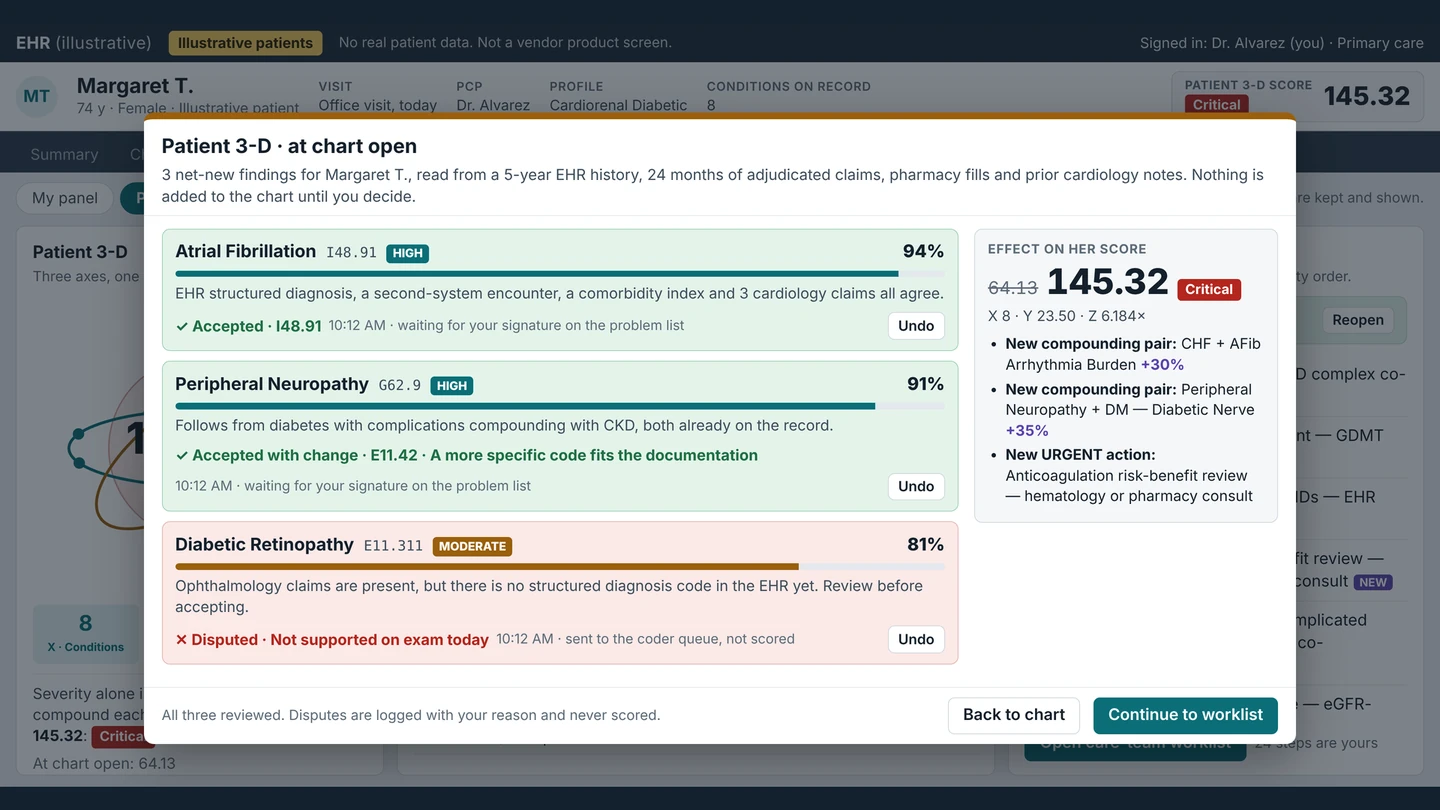
    The physician decides.
    Illustrative patientsInside the EHR the clinicians already use
  6. 6

    The care team acts on one live queue.

    Routed to the role that owns each step; the order exists only once it is signed, and nothing is ordered twice.
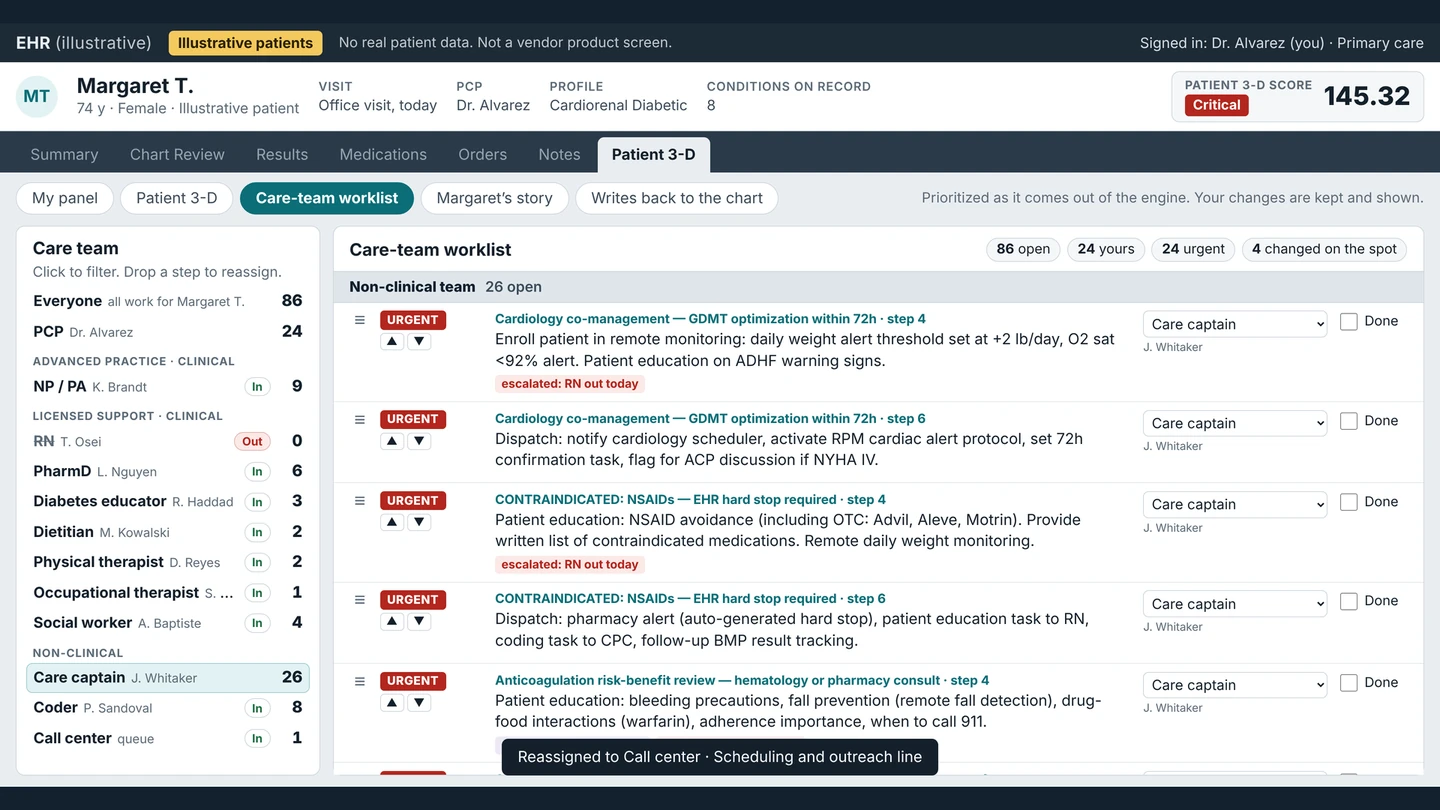
    The care team acts on one live queue.
    Illustrative patientsInside the EHR the clinicians already use
  7. 7

    What it is worth.

    Care already covered, documentation made complete, and the hidden tax made visible: every reason a member costs more, priced member by member.

  8. 8

    Built to pass any health system’s or health plan’s review.

    Fourteen rule-driven agents, every action logged with its reason. Standards end to end; it runs inside the client’s own environment.
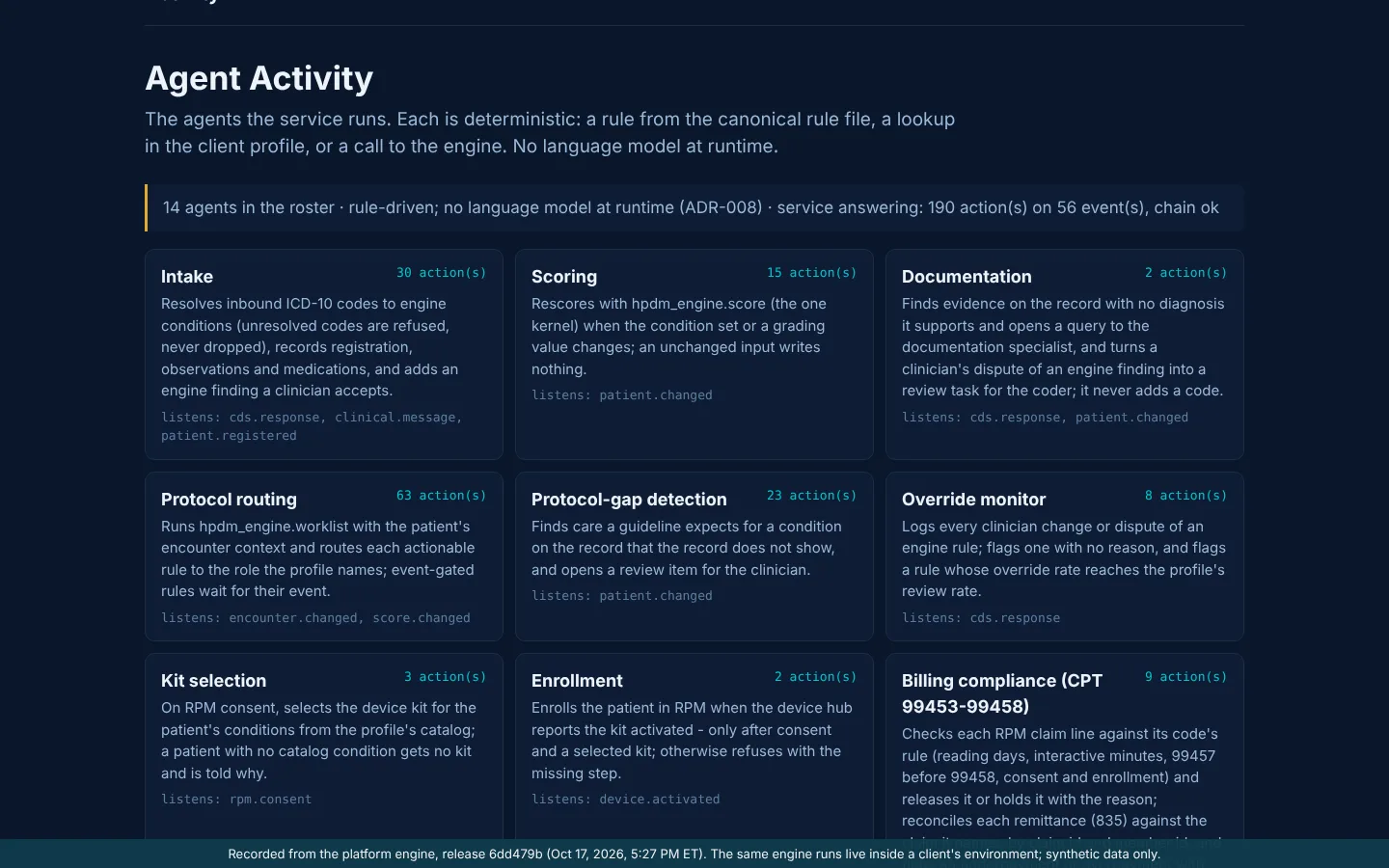
    Built to pass any health system’s or health plan’s review.
    Illustrative patientsRecorded from the platform engine
  9. 9

    No avoidable admission.

    She comes in for the specialist and the diagnostic she needs. What she avoids is the admission nobody planned.

Every source. As it happens.

  • The whole record

    EHR admissions, discharges and results in HL7 v2; the full record in FHIR R4; claims and remittances in X12; pharmacy fills; clinical notes. Each message lands once; a replayed message is recognized, never counted twice.

  • Live where it matters

    Lab results, orders, imaging, admissions and discharges arrive as they happen and the patient is rescored at once. Claims load as they arrive. The care team watches the same picture at the same moment.

  • Every source counts

    Each condition carries the sources that report it. The engine identifies; the clinician validates. The gap between the two is the finding: where systems don’t talk, where data is closed off, where care is missing.

It acts, and shows its work.

  • Fourteen agents

    Rule-driven agents carry every event: Intake, Scoring, Documentation, Protocol routing, Protocol-gap detection, Override monitor, Kit selection, Enrollment, Billing compliance, Dispatch, Prior authorization, Fraud, waste and abuse, Drift and Reporting. Every action is logged with the input it acted on and the reason.

  • Already in place

    Before it recommends a test or a visit, the engine checks whether it was done recently enough, against the guideline that sets the window: ADA, KDIGO, NCQA HEDIS, CMS, CDC. Nothing is ordered twice.

  • Notes read, never assumed

    Clinical notes are read for conditions documented but not coded, with negation handled. A suggestion goes to the clinician; it never changes a score on its own.

Her path, where you meet it.

From her record to the closed loop. Every step is a service already covered.

  1. She is seen.

    Her record arrives from every source — the EHR, claims, pharmacy, labs and notes — as it happens. The engine reads her conditions as one compounding trajectory, counts what other systems documented that her own record does not carry, and names what no single-disease guideline was watching for.

  2. Her physician opens the chart.

    The protocol is already there: nephrology within 48 hours, a medication reconciliation, a transitional-care visit — fired by her interactions, routed to the roles that own them, documented with the codes that pay for them. What is already done stays done: a recent eye exam or kidney panel is found, not ordered twice.

  3. Her home is connected.

    A monitoring kit chosen for her profile, not a generic box. Her blood pressure, weight and glucose reach a nurse before they reach an emergency room.

  4. Her care team runs on one queue.

    A Care Captain, a nurse triage line that never closes, a community health worker for the ride she couldn’t get — dispatched by the protocol, not by whoever noticed first. Everyone sees the same picture in real time, so no task is done twice.

  5. Her care is documented, billed and closed.

    Each action acknowledged, completed or disputed, date-stamped. Chronic care management, remote monitoring, transitional care — services already covered, now activated.

  6. Her outcomes are reported — and audited by someone who isn’t us.

    Every figure traces to an engine run. The audit lives in a store we write and cannot touch.

  7. No avoidable admission.

    When she needs a specialist or a diagnostic, she comes in for it. What she avoids is the admission nobody planned. That’s the outcome. Everything else is the machinery.

What your clinicians see.

  1. Events in

    A current list. An admission, discharge or new result reaches the engine within minutes, so the ranking they open reflects today.

  2. Claims

    The whole picture. Cost and use of care from your payers sit beside the clinical record, so a patient's rank reflects both.

  3. The full record

    Every patient ranked. The whole population is scored, not only the patient on screen, so no one is missed between visits.

  4. The Patient 3-D tab

    The ranked queue in the chart: the interaction named, the protocol, the assignment.

  5. Alert at chart open or ordering

    A card at the moment it matters, such as kidney function, heart failure and an NSAID on the outside medication list.

  6. Suggested order

    A referral or dose change, prepared and waiting in the order list for the clinician to sign.

  7. Note and "done" back to the chart

    A short note in the chart: what was flagged, who acted, when.

If Patient 3-D is unavailable, nothing in the EHR breaks. The tab shows unavailable, the alerts don't fire, and every workflow runs as it does today. Orders exist only once a clinician signs them.

Bringing it in

How it connects to your EHR, who does what, and how to start.

The implementation detail for your IT, security and operations teams: standards, the review it is built to pass, roles, how an engagement runs and the one-extract proof of value.

Learn more about implementation →

See it on your data.

The Patient Engine first, then the EHR your clinicians use. Then a proof of value on one extract, with your clinicians at the review table.